For many people, the family home is far more than just their most valuable asset. It is where children have grown up, where memories have been made and, for many, it represents stability during what is often one of the most stressful periods of their lives. It is therefore no surprise that the first question people ask is often about keeping the family home after separation.
In many cases, the answer is yes. It may be possible to keep the family home by buying your former partner’s interest in the property as part of your property settlement. However, whether this is possible depends on a range of legal and financial factors, including the value of the property, the equity available, your ability to refinance the mortgage and the overall division of assets between you and your former partner.
Importantly, there is no automatic rule that one person keeps the house, nor is there a rule that the house must always be sold. Every family’s circumstances are different, and the outcome will depend on what is just and equitable in the circumstances.
This article explains how the family home is treated following separation, how buying your former partner’s interest works and the options available if keeping the family home is important to you.
Table of Contents
Does One Person Automatically Get the Family Home?
No.
Many people assume that because they purchased the home, paid most of the mortgage or are the children’s primary carer, they automatically have a greater entitlement to keep the property. Australian family law does not work this way.
The family home forms part of the overall property pool to be divided between the parties. The Court does not determine ownership of each asset individually. Instead, it considers all assets, liabilities and financial resources before determining what overall division of property is just and equitable.
This means the person who ultimately keeps the family home is not necessarily the person whose name is on the title, the person who paid the deposit or even the person currently living there.
Rather, the family home is considered alongside other assets such as:
- Investment properties
- Bank accounts
- Superannuation
- Motor vehicles
- Businesses
- Shares and investments
- Personal belongings of significant value
Once the overall property settlement has been determined, one party may retain the family home while the other receives a greater share of other assets, or alternatively receives a financial payment representing their interest in the property.
But what if both parties want the family home after separation? Read our article on this topic: What happens if we both want the family home?
Can I Stay Living in the Family Home After Separation?
Yes.
Immediately following separation, it is common for one party to continue living in the family home while property settlement negotiations are ongoing.
This does not necessarily give that person a greater entitlement to the property. Equally, moving out does not mean you lose your interest in the home.
Despite the above, it can be optimal to remain in the family home where it is safe for you to do so, for a variety of reasons, the least of which is that it in some circumstances it puts you in a place of strategic advantage in a property settlement, purely from a practical perspective, because you have the benefit of continuing to live in the property, whilst a property settlement is negotiated.
Sometimes both parties continue living in the same property for a period after separation, often referred to as “separation under one roof”. This arrangement may occur for financial reasons or to minimise disruption for children while longer-term arrangements are being made.
Regardless of who remains in the home following separation, legal ownership of the property generally remains unchanged until a formal property settlement is reached.
How Does the Court Decide Who Keeps the Family Home?
If the parties cannot reach agreement themselves, the Court has the power to determine how the property pool should be divided.
The Court does not begin by asking who should receive the house. Instead, it follows the same approach used in all property settlement matters.
Broadly speaking, this involves considering:
- The assets, liabilities and financial resources of both parties.
- The financial contributions each party made throughout the relationship, including income, inheritances and assets brought into the relationship.
- The non-financial contributions made by each party, such as renovating the home or managing family finances.
- Contributions made as homemaker and parent.
- The future needs of each party, including factors such as income earning capacity, age, health and the ongoing care of children.
- Whether the proposed outcome is just and equitable.
Only after considering these matters does the Court determine the appropriate overall division of property.
The Court is not required to preserve a particular asset for either party. Its role is to determine an overall property settlement that is just and equitable, even if that ultimately requires the family home to be sold.
If one party wishes to retain the family home, the Court will also consider whether doing so is practical. For example, can that party refinance the mortgage? Can they meet the ongoing expenses associated with owning the property? Is retaining the home realistic in light of the overall property settlement?
In many cases, allowing one party to retain the family home provides stability for children and avoids the costs associated with selling and purchasing another property. However, each case depends on its own facts.
Is It Better to Keep or Sell the Family Home?
There is no single right answer.
For some families, retaining the family home provides continuity for children and allows one party to move forward without the stress of relocating.
For others, selling the property is the most practical solution. Selling may allow both parties to discharge the mortgage, access their share of the equity and purchase more affordable accommodation that better suits their financial circumstances following separation.
The decision often depends on factors such as:
- The amount of equity in the property.
- The size of the mortgage.
- Whether refinancing is possible.
- The overall value of the asset pool.
- The financial needs of both parties.
- Whether children will continue living primarily with one parent.
- Each party’s ability to meet future mortgage repayments and property expenses.
While emotions understandably play a significant role, it is also important to carefully consider the long-term financial implications before deciding whether keeping the family home is the right option.
Can I Buy My Ex Out of the House?
Yes, provided it is financially possible and forms part of an agreed or Court-ordered property settlement.
Buying your former partner’s interest in the family home means you become the sole owner of the property. Rather than selling the home and dividing the proceeds, one party keeps the property while the other receives a cash payment or other adjustment of property in their favour, for their interest.
The party not retaining the family home does not always receive a cash payment. In many cases, their entitlement is instead satisfied by receiving a greater share of other assets within the property settlement.
In many cases, the value of the family home is balanced against other assets in the property pool.
For example, one party may retain the family home while the other receives a greater share of superannuation, investments or cash. In other situations, the party retaining the home may refinance the mortgage and pay a lump sum to their former partner.
Every property settlement is different, and the right approach will depend on the parties’ overall financial circumstances.
If retaining the family home is important to you, it is generally beneficial to raise this early during property settlement negotiations. This allows both parties to explore practical solutions, including refinancing, before positions become entrenched.
How Is the Buyout Amount Calculated?
One of the biggest misconceptions is that buying your former partner out simply means paying them half of the home’s value, or half of the equity in the property.
In reality, the calculation is usually much more involved.
The first step is determining the current market value of the property. This may be done by agreement between the parties, through independent appraisals or by obtaining a formal valuation from a qualified valuer.
The mortgage and any other loans secured against the property are then deducted to determine the available equity.
For example:
- Current value of the home: $1,100,000
- Mortgage owing: $450,000
- Net equity: $650,000
If the parties are ultimately entitled to an equal division of the property pool and there are no other adjustments to account for, each party’s interest in the equity may be approximately $325,000.
However, this does not necessarily mean one party simply pays the other $325,000.
The family home is only one part of the overall property settlement. Other assets and liabilities may significantly affect the final outcome.
For example:
- One party may retain a larger share of superannuation.
- One party may keep investment properties or businesses.
- There may be motor vehicles, savings or investments that are divided differently.
- The Court may determine that one party should receive a greater percentage of the overall asset pool due to their future needs.
For this reason, the amount required to buy out your former partner is usually different from simply “half the equity.”
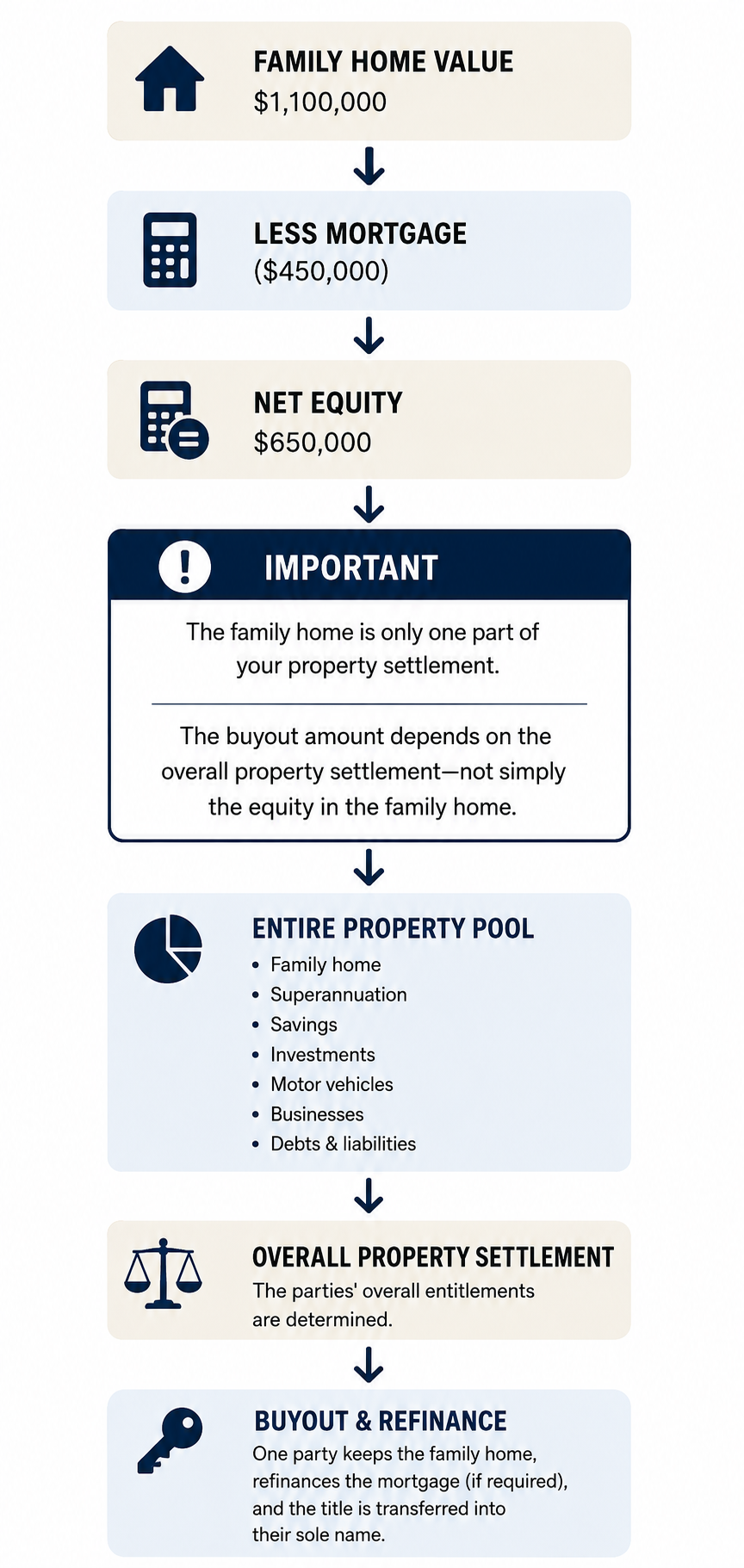
Example: Buying Out a Former Partner
Consider the following example:
- Family home value: $1,100,000
- Mortgage owing: $450,000
- Net equity: $650,000
At first glance, many people assume this means each party simply receives $325,000.
However, property settlements are not determined by looking at the family home in isolation.
For example, one party may retain the family home while the other receives a greater share of the parties’ superannuation, savings or investments. Alternatively, the party keeping the home may refinance the mortgage and make a lump sum payment to their former partner.
The final buyout amount depends on the parties’ overall property settlement, including all assets, liabilities and future needs. It is not simply calculated by dividing the equity in the family home in half.
Do I Need to Refinance the Mortgage?
In most cases, yes.
If both parties are currently borrowers under the existing mortgage, the lender will require the person retaining the property to refinance the loan into their sole name before removing the other party from the mortgage.
This protects the party who is leaving the property from remaining legally responsible for a debt they no longer control.
Importantly, the bank will make its own assessment about whether you can afford the loan.
The lender may consider:
- Your income.
- Your employment.
- Existing debts.
- Living expenses.
- Child support or spousal maintenance obligations.
- The amount you wish to borrow.
Even if you and your former partner agree that you should keep the home, the refinance can only proceed if the lender approves the application.
If refinancing is not approved, alternative arrangements may need to be considered, including sale of the property.
What If I Cannot Refinance the Mortgage?
This is a situation many people face after separation.
While you may have comfortably managed the mortgage during the relationship with two incomes, qualifying for the loan on a single income can be much more difficult.
If refinancing is not possible, your options may include:
- Selling the family home and dividing the net proceeds.
- Negotiating a different property settlement that reduces the amount you need to borrow.
- Using other assets to offset your former partner’s entitlement.
- Delaying the sale by agreement for a period of time, particularly where young children are involved.
Although many people are emotionally attached to the family home, it is important to consider whether retaining it is practical and financially sustainable over the long term.
Owning a home involves more than mortgage repayments. You will also need to budget for rates, insurance, maintenance and unexpected repairs.
In some cases, selling the property allows both parties to make a fresh start with greater financial security.
What If There Is Very Little Equity in the Property?
Not every family home has substantial equity.
If the mortgage is close to the property’s value, there may be very little equity available to divide between the parties.
This can affect whether buying your former partner’s interest is worthwhile or even possible.
In some cases, there may also be insufficient equity to refinance the existing mortgage. Where this occurs, the parties may need to explore alternative settlement options or consider selling the property, even if one party would prefer to retain it.
For example, if a home is worth $800,000 and the mortgage is $760,000, there is only $40,000 in equity before taking into account selling costs or other adjustments.
In these circumstances, it may be more practical for the parties to consider selling the property or negotiating another arrangement as part of the overall property settlement.
Can We Agree on the Buyout Ourselves?
Absolutely.
In fact, most property settlements are resolved through negotiation rather than Court proceedings.
If you and your former partner can reach an agreement about who will retain the family home and how the remaining assets will be divided, you can usually avoid the cost, delay and uncertainty associated with litigation.
However, it is important that any agreement is properly documented.
Simply transferring money or changing the title without obtaining legal advice may expose both parties to future legal or financial risks. In order to protect your future property interests, you should not make any cash payment to your former partner in exchange for keeping the property, until the property settlement agreement is documented by either a consent order or a binding financial agreement.
A properly documented property settlement provides certainty, helps finalise financial matters, it may result in you being exempted from Stamp Duty or CGT upon transfer of the property, and, it protects you from a property settlement claim being made in the future.
Do I Need Consent Orders or a Binding Financial Agreement?
If you and your former partner reach an agreement about who will keep the family home, it is important to ensure that the agreement is legally documented.
Many people mistakenly believe that once the property title has been transferred or the buyout amount has been paid, the matter is finalised. In reality, without formalising your property settlement, either party may be able to make further property claims against the other in the future.
Furthermore, by doing a consent order or a binding financial agreement you may be extempt from stamp duty or CGT. You should ensure you receive financial advice from your accountant about your options and the tax consequences of each, before formalising your property settlement.
There are generally two ways to formalise a property settlement:
- Consent Orders made by the Federal Circuit and Family Court of Australia.
- A Binding Financial Agreement prepared in accordance with the requirements of the Family Law Act 1975.
Both options can permanently finalise property matters, although each has different requirements and may be more suitable depending on your individual circumstances.
Obtaining legal advice before deciding which option is appropriate is important, as the wrong approach may have significant legal and financial consequences.
What Happens to the Title of the Family Home?
Once a property settlement has been finalised and any refinancing requirements have been satisfied, the ownership of the property can be transferred.
If one party is retaining the family home, the other party’s interest is generally transferred so that the remaining party becomes the registered owner.
The exact process will depend on the circumstances, including whether there is an existing mortgage and the requirements of the lender.
Both parties will need to retain a Conveyancer to facilitate the transfer of the property, in accordance with the agreement reached.
Your conveyancer will generally work with the lender and the relevant State or Territory titles office to complete the transfer and ensure the necessary documents are correctly prepared and lodged.
What If My Former Partner Refuses to Sell Their Interest?
Sometimes one party wishes to keep the family home, but the other refuses to cooperate.
In many cases, this does not necessarily prevent a property settlement from proceeding.
If negotiations are unsuccessful, the Court has the power to make orders dealing with the family home as part of the overall property settlement.
Depending on the circumstances, the Court may order:
- That the property be sold.
- That one party retain the property upon payment of an agreed or determined amount to the other.
- That documents be signed to facilitate the transfer of ownership.
- That one party do everything necessary to complete the refinance process.
Every case depends on its individual circumstances. The Court’s primary objective is to achieve a property settlement that is just and equitable.
For this reason, refusing to cooperate does not necessarily prevent a property settlement from being finalised.
What If My Former Partner Will Not Sign the Transfer Documents?
Occasionally, a former partner refuses to sign the documents required to transfer the family home, even after an agreement has been reached or Court orders have been made.
If Court proceedings have been commenced, the Court has the power to make orders to overcome this situation. In appropriate cases, orders can be made that allow the transfer to proceed even if one party refuses to sign the necessary documents.
This ensures that one party cannot indefinitely delay the implementation of a property settlement simply by refusing to cooperate.
Frequently Asked Questions
Can I buy my ex out if my name is not on the title?
Potentially, yes.
The name recorded on the property’s title does not have an impact on the entitlements of the parties to that property. Property settlements are determined by family law principles rather than strict legal ownership. Even if you are not registered as an owner, you may still have an entitlement to an interest in the family home depending on your contributions and the individual circumstances of the case.
Can I keep the family home after separation if I have primary care of the children?
Possibly.
The ongoing care of children is one factor the Court may consider when determining a property settlement, but it does not dictate the outcome of the case. The 5 step process will be undertaken by the Court in ascertaining what a just and equitable division of assets is, including the % division and the actual division of assets between the parties. There is no automatic rule that the parent with primary care keeps the family home.
Each matter is determined based on the individual circumstances of the case.
Can I keep the family home after separation if my former partner agrees?
Yes, provided the arrangement is properly documented and you are able to meet any refinancing requirements.
Simply agreeing between yourselves is usually not enough. It is important to obtain legal advice to ensure the property settlement is legally finalised, to protect yourself in the future from any further claims.
How long do I have to transfer the family home after separation?
There is no single timeframe that applies to every family.
However, strict time limits can apply to property settlement applications following divorce or the breakdown of a de facto relationship. Seeking legal advice early can help protect your rights and avoid unnecessary complications.
Although there is no fixed deadline for transferring the property itself, delays can create practical and financial complications, particularly if property values, interest rates or lending criteria change while negotiations are ongoing.
Getting Advice About Keeping the Family Home after separation
For many people, the family home is both their largest financial asset and the place they most want to preserve following separation.
Whether you are hoping to buy out your former partner, negotiate a property settlement that allows you to retain the family home or simply understand your legal options, obtaining legal advice early can make a significant difference. Early advice can help you understand your likely entitlement, avoid costly mistakes during negotiations, identify practical solutions for retaining the home and ensure any agreement is properly documented to protect your future financial interests.
At Barton Family Lawyers, we regularly assist clients with property settlements involving the family home. We can advise you about your legal entitlements, negotiate on your behalf and assist in documenting any agreement reached so that your financial relationship is properly finalised.
Every family’s circumstances are different. Obtaining advice that is tailored to your individual situation can help you make informed decisions and move forward with confidence following separation.
For advice in relation to your individual circumstances, contact us to book a reduced rate consultation with one of our experienced Brisbane Family Lawyers today.