When a couple separates, it is common for them to begin building separate financial lives. One person might purchase a new home, establish a business or increase their superannuation. But what happens if they do not finalise their property settlement for several years? We are often asked whether you get to keep property acquired after separation.
This article answers the question: Does property acquired after separation belong solely to the person who acquired it, or can their former partner still have a claim?
The recent decision of Roberts & Roberts [2026] FedCFamC2F 1154 provides an important reminder that separating does not necessarily mean that financial and non-financial contributions stop being relevant.
Table of Contents
What Happened in Roberts & Roberts?
The husband and wife had been together for approximately 12 years and had been separated for almost eight years.
They had two children, both of whom had significant additional needs.
Following separation, the husband continued working, purchased another property and established a business.
During the same period, the wife remained primarily responsible for caring for the children, including managing their medical, educational, behavioural and day-to-day support needs.
When their property settlement came before the Federal Circuit and Family Court of Australia, the husband argued that the property and business he had acquired after separation should be treated separately from the assets accumulated during the relationship.
In other words, he wanted to keep the wealth he had built after separation largely outside the wife’s claim.
What Did the Husband Argue?
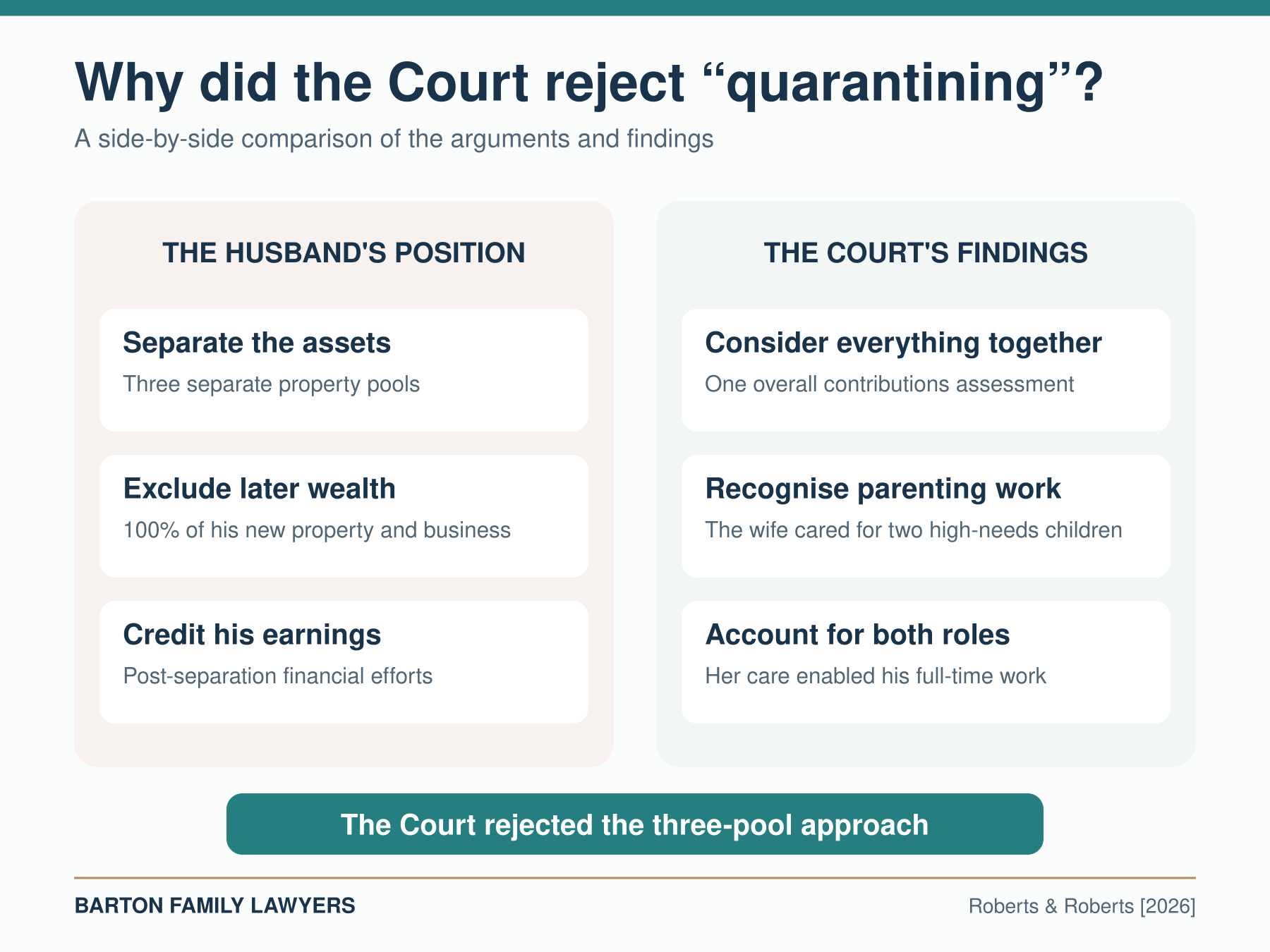
The husband proposed dividing the parties’ assets into three separate groups:
- Property and liabilities accumulated during the relationship.
- The property and business he acquired after separation.
- The parties’ superannuation.
The husband argued that he should retain 100% of the property and business he had acquired after separation (Group 2), on the basis that those assets resulted from his own financial efforts.
He also argued that the parties’ superannuation (Group 3) should be assessed separately, proposing that he receive 70% of their combined superannuation entitlements.
The husband relied on the fact that his superannuation had increased by approximately $184,000 since separation, which he attributed to his own financial contributions.
Under his proposed approach, the husband would have received approximately 64.5% of the overall property pool based on contributions.
However, the Court rejected his proposed approach for two important reasons.
First, the Court recognised that the wife’s substantial parenting contributions after separation had enabled the husband to work full-time, purchase property and establish his business. It would therefore be inappropriate to consider his financial contributions without also recognising her ongoing parenting contributions.
Second, the Court found that there was insufficient evidence to establish how much of the increase in the husband’s property equity and superannuation resulted from his own financial efforts, as opposed to market forces or investment growth.
The Court therefore rejected the husband’s proposed three-group approach and determined that the parties’ contributions should be assessed together, taking into account all their assets and their respective contributions both during the relationship and after separation.
What Did the Court Decide about the Husband’s property acquired after separation?
The Court determined that the parties’ contributions should be considered together, taking into account the entire relationship and the period following separation.
Importantly, the Court recognised that while the husband had been making financial contributions, the wife had continued making substantial parenting and homemaking contributions.
The wife’s responsibility for caring for two children with significant additional needs had enabled the husband to work full-time, purchase property and establish his business.
The Court considered that it would be inappropriate to recognise the husband’s financial contributions after separation without also recognising the wife’s ongoing contributions during that same period.
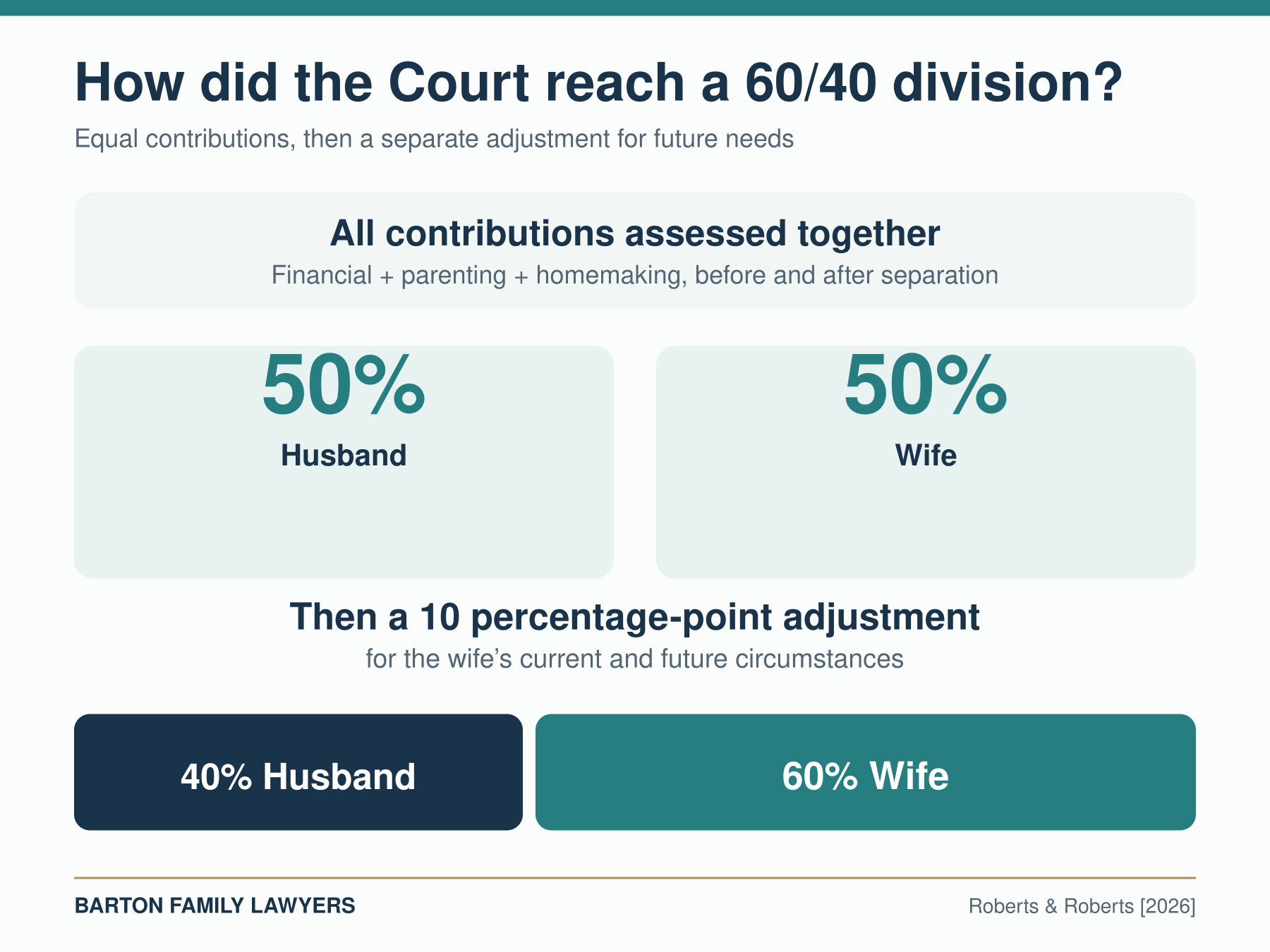
The Court therefore assessed their overall contributions as equal.
However, that was not the end of the assessment.
Why Did the Wife Receive 60% of the Property?
After assessing contributions as equal, the Court considered the parties’ current and future financial circumstances.
The wife continued to have primary responsibility for the children’s care, which affected her ability to work and earn an income.
She also needed to secure appropriate housing for herself and the children.
The Court considered several factors, including:
- The difference between the parties’ incomes.
- The wife’s ongoing responsibility for the children’s care.
- The children’s significant support and therapeutic needs.
- The impact of those responsibilities on the wife’s earning capacity.
- The wife’s need to obtain suitable housing.
Taking these circumstances into account, the Court made a further adjustment of 10% in the wife’s favour.
The final property division was 60% to the wife and 40% to the husband.
Does Property Acquired After Separation Form Part of a Property Settlement?
Yes. Property acquired after separation forms part of the property considered in a property settlement.
A common misunderstanding is that once a couple separates, anything either person acquires afterwards automatically belongs to them alone.
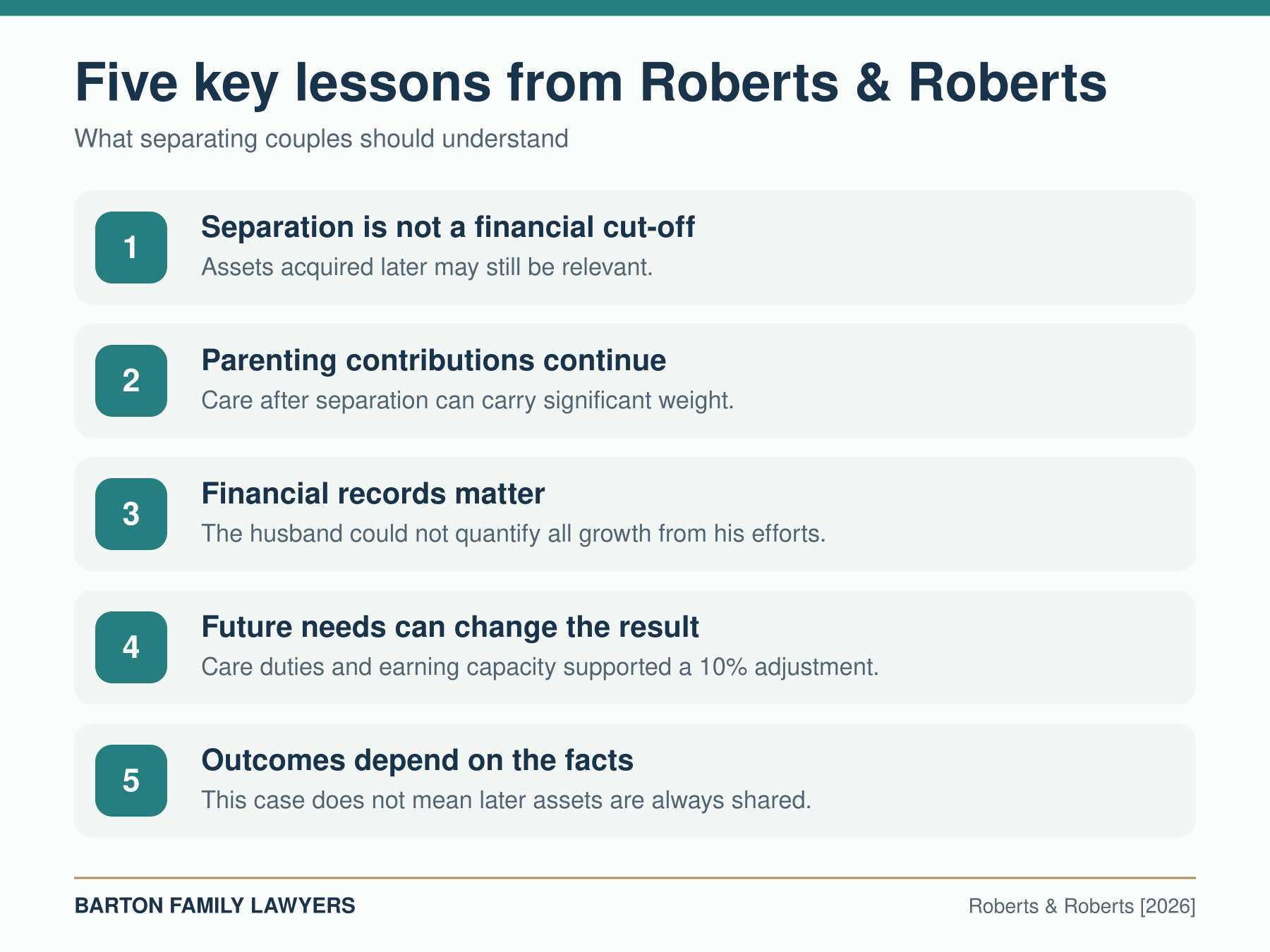
However, separation does not create an automatic financial cut-off point.
When determining a property settlement, the Court generally considers the assets and liabilities of both parties at the time of the proceedings, including property acquired after separation.
The important question is how the Court assesses each party’s contributions towards those assets.
For example, one party may have purchased a property or established a business entirely through their own financial efforts after separation. Those contributions may be significant when determining how the property should be divided.
However, the Court must also consider the other party’s contributions, including any ongoing parenting and homemaking responsibilities.
In Roberts & Roberts, the Court recognised that although the husband had acquired property and established a business after separation, the wife’s substantial parenting contributions had enabled him to pursue those financial opportunities.
The Court therefore determined that the parties’ contributions should be assessed together, rather than separately assessing the husband’s post-separation assets.
The key distinction is that property acquired after separation is included in the property settlement assessment, but the weight given to each party’s contributions towards that property will depend on the circumstances of the case.
Why Are Parenting Contributions Important After Separation?
One of the most significant aspects of Roberts & Roberts was the Court’s recognition of the wife’s parenting contributions during the lengthy period following separation.
Although the parties were no longer living together, their respective contributions remained connected.
The husband was able to focus on his employment and business activities while the wife carried the substantial responsibility of caring for their children.
The Court recognised that these contributions were different in nature but both had significant value.
This is an important reminder that contributions to a property settlement are not limited to earning income, purchasing assets or making mortgage repayments.
Parenting, homemaking and other non-financial contributions can also be significant, including those made after separation.
What If You Have Been Separated for Several Years Without a Property Settlement?
If you have separated but have not finalised your property settlement, changes to either person’s financial circumstances may affect the eventual outcome.
For example, one person might:
- Purchase another property.
- Establish or expand a business.
- Receive an inheritance.
- Accumulate additional superannuation.
- Pay down substantial debts.
At the same time, the other person might continue making significant parenting or other non-financial contributions.
These circumstances may all be relevant when determining a fair property settlement.
It is also important to understand that there are time limits for commencing property settlement proceedings.
For married couples, the usual time limit is 12 months after a divorce becomes final. For de facto couples, the usual time limit is two years after separation. Applications outside those periods generally require the Court’s permission, unless another statutory exception applies.
Simply separating does not finalise your financial relationship or determine how your property will ultimately be divided.
What Can We Learn From Roberts & Roberts when it comes to property acquired after separation?
The decision highlights an important distinction between separating and finalising a property settlement.
Although the husband had acquired property and established a business after separation, the Court did not consider his financial contributions in isolation.
Instead, it considered the contributions of both parties throughout the relationship and the years following separation.
The decision does not mean that property acquired after separation must always be shared, or that separate assets can never be assessed differently.
Rather, it demonstrates that the date of separation alone does not determine whether an asset will be considered in a property settlement.
Each case depends on its own facts, including the nature and extent of the parties’ respective contributions.
Get advice about your property acquired after separation
If you have separated and are uncertain about how your property, business interests or superannuation may be treated, obtaining legal advice can help you understand your position.
This is particularly important where you have been separated for an extended period or where either party has acquired significant assets since separation.
At Barton Family Lawyers, we can assist you in understanding your rights and obligations and working towards a property settlement that reflects your individual circumstances.
Contact Barton Family Lawyers to arrange an appointment with one of our experienced family lawyers.