How long does a property settlement take? It is one of the most common questions people ask after separating from their spouse or de facto partner. Understandably, many people want to know how quickly they can finalise their financial relationship, move forward with their lives and put the uncertainty behind them.
The answer is that every property settlement is different. Some couples are able to reach an agreement within a few months, while others may spend more than a year negotiating their financial arrangements. If Court proceedings become necessary, the process can take considerably longer.
There is no fixed timeframe that applies to every property settlement. The time it takes will depend on a range of factors, including the complexity of your financial circumstances, whether both parties provide complete financial disclosure, whether property valuations are required and whether an agreement can be reached without the Court determining the outcome.
The good news is that most property settlements are resolved without a Judge making the final decision. In many cases, the length of time is influenced not by the law itself, but by practical issues such as gathering financial information, obtaining valuations, negotiating an agreement and completing the steps necessary to implement the settlement.
In this guide, we explain the typical timeframe for a property settlement in Australia, what usually happens throughout the process, the factors that commonly cause delays and the practical steps you can take to help move your matter forward.
Table of Contents
Is There a Standard Timeframe for a Property Settlement?
No.
There is no law that requires every property settlement to be completed within a certain number of weeks or months.
Instead, every property settlement progresses at its own pace.
Some matters are relatively straightforward. For example, if both parties have modest assets, agree on the value of those assets and are motivated to negotiate, a property settlement may be finalised within a few months.
Other matters are considerably more complex. Property settlements involving businesses, trusts, multiple investment properties, disputed asset values or incomplete financial disclosure often take much longer to resolve.
The important thing to remember is that there is no “average” property settlement. Every family has different financial circumstances, different priorities and different issues that need to be resolved before an agreement can be reached.
How Long Does a Property Settlement Usually Take?
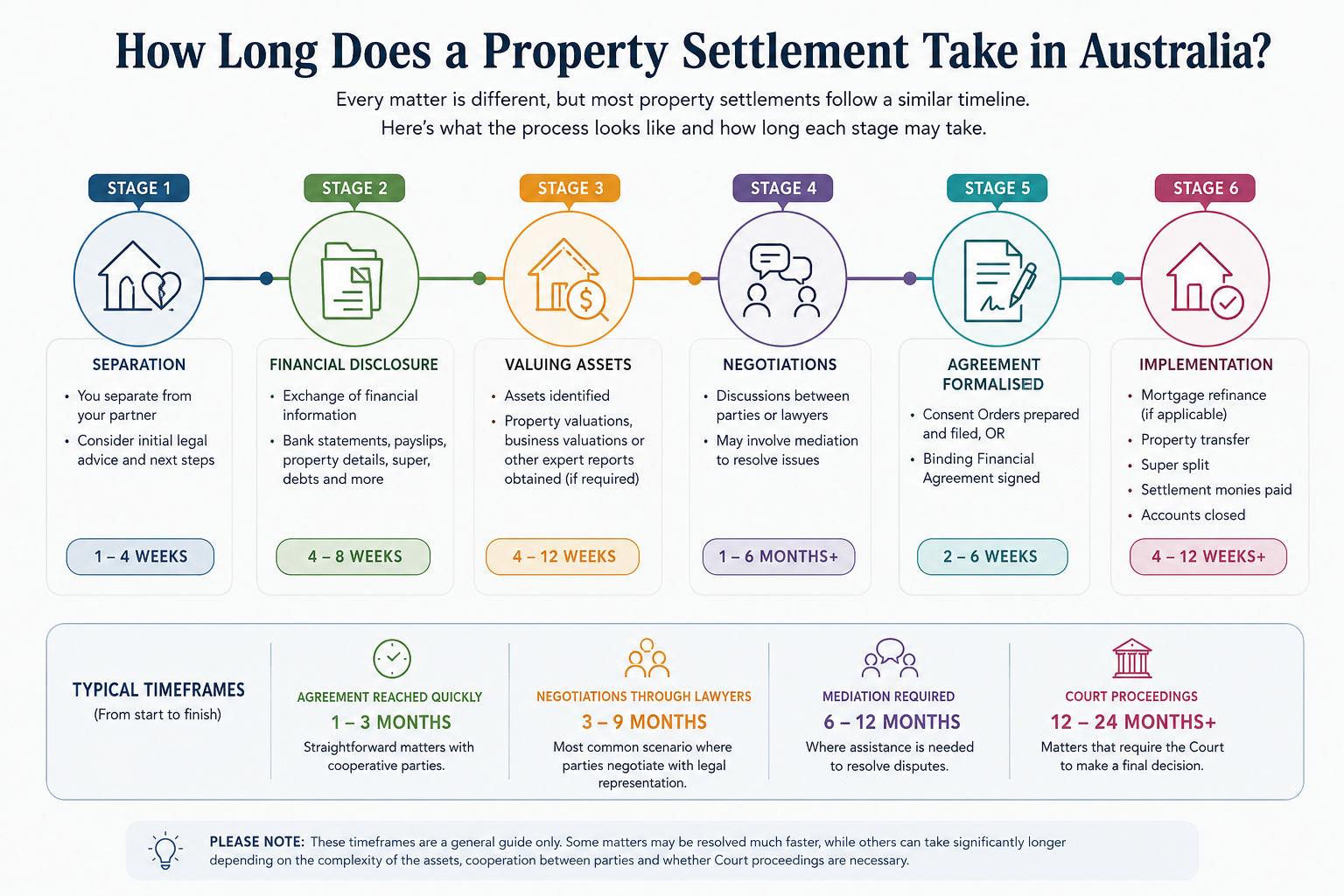
Although every matter is different, the following timeframes provide a general guide only.
| Circumstances | Typical Timeframe |
|---|---|
| Straightforward agreement between the parties that needs to be legally formalised | 1–3 months |
| Negotiations through lawyers | 3–9 months |
| Mediation required | 6–12 months |
| Court proceedings | 12–24 months or longer |
These timeframes are examples only and should not be taken as guarantees.
Some property settlements progress much faster, while others take considerably longer because of the issues involved.
Rather than focusing on the overall timeframe, it is often more helpful to understand why property settlements take time. In many cases, delays occur because important practical steps need to be completed before meaningful negotiations can occur.
What Usually Happens During a Property Settlement?
While every matter is different, most property settlements follow a similar sequence of events.
Understanding these stages can help explain why some matters are resolved relatively quickly while others take considerably longer.
Stage 1 – Separation
The process usually begins after the parties separate.
During this time, many people seek legal advice to understand their rights and obligations before making significant financial decisions.
Some couples are able to begin discussing a property settlement almost immediately. Others may need time before they are emotionally or practically ready to negotiate.
Stage 2 – Financial Disclosure
Before meaningful negotiations can occur, both parties need to understand the financial position.
This is known as financial disclosure.
Financial disclosure generally involves exchanging information about:
- bank accounts
- superannuation
- real estate
- mortgages
- loans
- credit cards
- investments
- businesses
- trusts
- income
- liabilities and debts.
Without complete financial disclosure, it is often impossible to properly negotiate a property settlement because neither party has a complete understanding of the assets and liabilities that form part of the property pool and the financial circumstances of both parties.
Stage 3 – Valuing Assets
Once financial information has been exchanged, the parties need to determine the value of particular assets.
This commonly includes:
- the family home
- investment properties
- businesses
- motor vehicles
- share portfolios
- valuable personal property.
Sometimes the parties agree on the value of these assets.
In other cases, independent valuers may need to be engaged to prepare expert reports before negotiations can continue.
Stage 4 – Negotiating the Property Settlement
After financial disclosure has been completed and assets have been valued, negotiations can begin.
Many property settlements are resolved through discussions between the parties or their lawyers.
If agreement cannot be reached, mediation may assist the parties in resolving the remaining issues without the need for Court proceedings.
Stage 5 – Formalising the Agreement
Once an agreement has been reached, it should generally be documented so that it becomes legally binding.
Depending on the circumstances, this may occur through:
- Consent Orders; or
- a Binding Financial Agreement.
Formalising the agreement provides certainty for both parties and allows the settlement to be implemented.
Stage 6 – Implementing the Settlement
Even after an agreement has been reached, there are often practical steps that still need to be completed.
These may include:
- refinancing the mortgage
- transferring ownership of real estate
- splitting superannuation
- paying settlement monies
- closing joint bank accounts
- completing conveyancing documentation.
Only once these steps have been completed has the property settlement been fully implemented.
Typical Property Settlement Timeline
Although every matter is different, the following example demonstrates how a straightforward property settlement may progress.
Weeks 1–4
- Separation
- Initial legal advice
- Financial documents gathered
↓
Months 2–3
- Financial disclosure exchanged
- Assets identified
- Property valuations obtained (if required)
↓
Months 3–6
- Negotiations commence
- Mediation (if required)
- Agreement reached
↓
Months 4–8
- Consent Orders or Binding Financial Agreement prepared
- Agreement formalised
↓
Months 5–9
- Mortgage refinanced (if applicable)
- Property transferred
- Superannuation split implemented
- Property settlement completed
It is important to remember that this is only an example, where the matter is straight forward, and the parties are both ready willing and able to undertake the processes necessary with respect to disclosure, valuations and thereafter, their willingness to participate in meaningful negotiations to resolve their financial matters.
Some matters may progress much faster, while others can take considerably longer depending on the issues involved and whether both parties are able to cooperate throughout the process.
The next question many people ask is why one property settlement takes three months while another takes two years.
The answer usually lies in the practical issues that arise during negotiations, rather than the legal process itself.
What Can Delay a Property Settlement?
One of the biggest misconceptions about property settlements is that delays are usually caused by the Court or the legal process itself.
In reality, most delays occur because important practical steps need to be completed before meaningful negotiations can take place. Even where both parties are motivated to resolve matters quickly, issues such as obtaining financial information, valuing assets or arranging finance can add weeks or months to the overall process.
The process can further be delayed if one party does not agree to provide certain disclosure or where they inhibit the process of valuations taking place.
Understanding what commonly causes delays can help you set realistic expectations and, in some cases, avoid unnecessary setbacks.
Financial Disclosure Has Not Been Completed
One of the most common reasons a property settlement takes longer than expected is because financial disclosure has not been completed.
Under Australian family law, both parties are generally required to provide full and frank disclosure of their financial circumstances. This allows each person to properly understand the assets, liabilities and financial resources that may be relevant to the property settlement.
Financial disclosure commonly includes documents relating to:
- bank accounts
- superannuation
- income
- tax returns
- real estate
- mortgages
- investments
- businesses
- trusts
- liabilities and debts.
If one party delays providing documents or provides incomplete information, negotiations often cannot progress until the missing information has been obtained.
For this reason, exchanging complete financial disclosure as early as possible is one of the most effective ways to help move a property settlement forward.
Property or Business Valuations Are Required
Another common cause of delay is determining what assets are actually worth.
Many couples can agree on the value of certain assets, particularly where recent market information is available. However, disagreements frequently arise about the value of more significant assets, particularly the family home, investment properties or privately owned businesses.
Where agreement cannot be reached, it may be necessary to obtain an independent valuation from an appropriately qualified expert.
Depending on the type of asset, arranging an inspection, preparing a valuation report and allowing both parties time to consider the report can add several weeks to the process.
In more complex matters involving multiple properties or business interests, valuations can become one of the longest stages of the property settlement.
Negotiations Take Time
Many people assume negotiations consist of one or two conversations before an agreement is reached.
In reality, property settlement negotiations often occur over several weeks or months.
Offers may be exchanged between the parties or their lawyers, additional financial information may be requested and new proposals may be considered as negotiations progress.
It is also common for negotiations to pause while further documents are obtained or advice is sought.
While this can sometimes feel frustrating, careful negotiations often allow the parties to resolve their matter without the expense, uncertainty and delay of Court proceedings.
Mediation Is Required
If negotiations reach an impasse, mediation may assist the parties to move forward.
During mediation, an independent mediator helps the parties explore possible solutions and negotiate a resolution.
Some matters settle during the mediation itself, while others continue negotiating afterwards before an agreement is eventually reached.
Although arranging mediation may add time to the process, it is often considerably faster and more cost-effective than commencing Court proceedings.
One Party Is Not Cooperating
Property settlements generally progress much more quickly where both parties are willing to engage in the process.
Unfortunately, this is not always the case.
Sometimes one party:
- delays responding to correspondence
- refuses to provide financial disclosure
- refuses to agree to valuations
- repeatedly changes their position
- refuses to participate in negotiations.
Where this occurs, the property settlement may take considerably longer to resolve and legal intervention may become necessary to move the matter forward.
Refinancing the Family Home
If one party wishes to retain the family home, refinancing is often required before the property can be transferred into their sole name.
Obtaining finance approval can take time.
The lender may require updated income information, property valuations or additional documentation before approving the loan.
If finance is declined, the parties may need to reconsider whether the property can realistically be retained, which can result in further negotiations.
For many families, refinancing is one of the final practical steps before the property settlement can be completed.
To avoid any delays associated with the refinance process, and to ensure that any offers made with respect to a refinance are practical, it is generally recommended that you receive advice early in the process from a broker about your capacity to refinance the home, including any additional cash payment you may need to make to the other party.
Parenting Matters Are Being Negotiated at the Same Time
Although parenting matters and property settlements are separate legal issues, they are often negotiated simultaneously.
For example, one party may be waiting until parenting arrangements have been finalised before making long-term financial decisions about the family home.
Where parenting negotiations become more complex, financial negotiations may also progress more slowly.
Separating these issues where possible can sometimes assist the parties to resolve at least one aspect of their separation sooner.
Court Proceedings Become Necessary
The majority of property settlements are resolved by agreement without a Judge making the final decision.
However, where negotiations are unsuccessful, Court proceedings may become necessary.
Once a matter enters the Court system, the timetable is largely determined by the Court.
Directions hearings, mediation, expert reports and, if necessary, a final hearing all take time to arrange.
Even after Court proceedings have commenced, negotiations can continue, and most matters settle before a final hearing takes place.
For this reason, commencing Court proceedings does not necessarily mean the matter will proceed all the way to trial.
Having said that, court proceedings are costly and emotionally draining. Accordingly, where both parties are cooperating with the process, and neither party putting forward an unrealistic position that would not be entertained by the Court, and there are no other urgent reasons necessitating the commencement of court proceedings, it is usually in your financial and emotional best interests to negotiate an agreement with the assistance of lawyers, out of court, through negotiations and/or mediation.
Complex Financial Circumstances
Some property settlements simply require more time because of the nature of the parties’ financial affairs.
Examples include:
- family businesses
- discretionary trusts
- self-managed superannuation funds
- multiple investment properties
- overseas assets
- complex investment portfolios.
These matters often require additional financial documents, expert advice or specialist valuations before negotiations can be finalised.
While this may increase the overall timeframe, taking the time to properly identify and value all relevant assets is an important part of achieving a fair and informed property settlement.
Can Anything Be Done to Avoid Delays?
Not every delay can be prevented.
However, there are practical steps that often help property settlements progress more efficiently.
These include:
- obtaining legal advice early, before things hit the fan
- providing complete financial disclosure as soon as possible
- responding promptly to requests for information
- obtaining early valuations where appropriate
- remaining open to genuine negotiations
- considering mediation before commencing Court proceedings.
Although every matter is different, early preparation and constructive communication often help reduce unnecessary delays and place the parties in a stronger position to reach an agreement.
What Happens While We Are Waiting for a Property Settlement?
One of the biggest concerns people have after separation is what happens while their property settlement is still being negotiated.
Although the property settlement may not be finalised for several months, life continues in the meantime. Decisions often need to be made about the family home, household expenses, joint bank accounts and other financial commitments.
The arrangements that work for one family may not be appropriate for another, but these issues are commonly discussed early in the negotiation process.
Who Pays the Mortgage?
There is no automatic rule about who must continue paying the mortgage after separation.
Some couples continue making the repayments jointly until a property settlement is reached. In other situations, one party may remain living in the home and make the repayments themselves, while in some cases alternative arrangements are negotiated.
The approach will depend on each family’s circumstances and should be considered as part of the overall financial picture.
Can One Person Stay in the Family Home?
Yes.
It is common for one party to remain living in the family home while negotiations are taking place, particularly where children are involved.
Remaining in the home does not automatically mean that person will ultimately retain ownership of the property as part of the final property settlement.
For more information on this topic read our article: Who Stays in the family home after separation?
Can Assets Be Sold Before the Property Settlement Is Finalised?
Sometimes.
However, significant assets should generally not be sold or transferred without first obtaining legal advice or reaching an agreement with the other party.
Selling assets prematurely can complicate negotiations and, in some circumstances, create additional disputes.
Do Joint Bank Accounts Need to Be Closed?
Not necessarily.
Some separated couples continue operating joint accounts for a period of time, while others choose to separate their finances shortly after separation.
If joint accounts remain open, both parties should understand how those accounts will be used while negotiations continue.
Planning these practical issues early often helps reduce conflict and uncertainty while the property settlement is being negotiated.
Frequently Asked Questions
Can a property settlement be completed before a divorce?
Yes. A property settlement can generally be negotiated and finalised before a divorce order is granted.
How long does a straightforward property settlement take?
Where both parties cooperate, provide prompt financial disclosure and reach an agreement quickly, some property settlements can be finalised within a few months.
Does every property settlement require mediation?
No. Many property settlements are resolved through negotiations without formal mediation. However, mediation can be an effective way of resolving disputes where negotiations have stalled.
Will refinancing delay my property settlement?
It can. If one party is retaining the family home, obtaining finance approval and completing the refinance process may extend the overall timeframe, so it is wise to get advice early in the process about your capacity to refinance.
What if my former partner refuses to negotiate?
If negotiations are unsuccessful, legal options may be available to move the matter forward, including commencing Court proceedings where appropriate.
Do most property settlements go to Court?
No. Most property settlements are resolved by agreement without a Judge determining the outcome.
How long does the Court process usually take?
Every case is different, but property settlements that proceed through the Court system generally take significantly longer than matters resolved by agreement.
Does a more complex asset pool mean the property settlement will take longer?
Often, yes. Matters involving businesses, trusts, investment properties or other complex financial structures usually require additional information, valuations and negotiations, which may increase the overall timeframe.
Getting Advice About Your Property Settlement
Every property settlement is different. While some matters can be resolved relatively quickly, others take longer because of the complexity of the financial circumstances, the need for property valuations or difficulties reaching an agreement.
Understanding the process and the factors that commonly cause delays can help you set realistic expectations and make informed decisions throughout your separation.
At Barton Family Lawyers, we regularly assist clients with negotiating and finalising property settlements involving family homes, investment properties, businesses, superannuation and other complex financial assets. We can explain each stage of the process, help identify issues that may affect your timeframe and work with you to resolve your matter as efficiently as possible.
If you would like advice about your property settlement, contact Barton Family Lawyers to arrange a reduced-rate initial consultation with one of our experienced Brisbane family lawyers.